

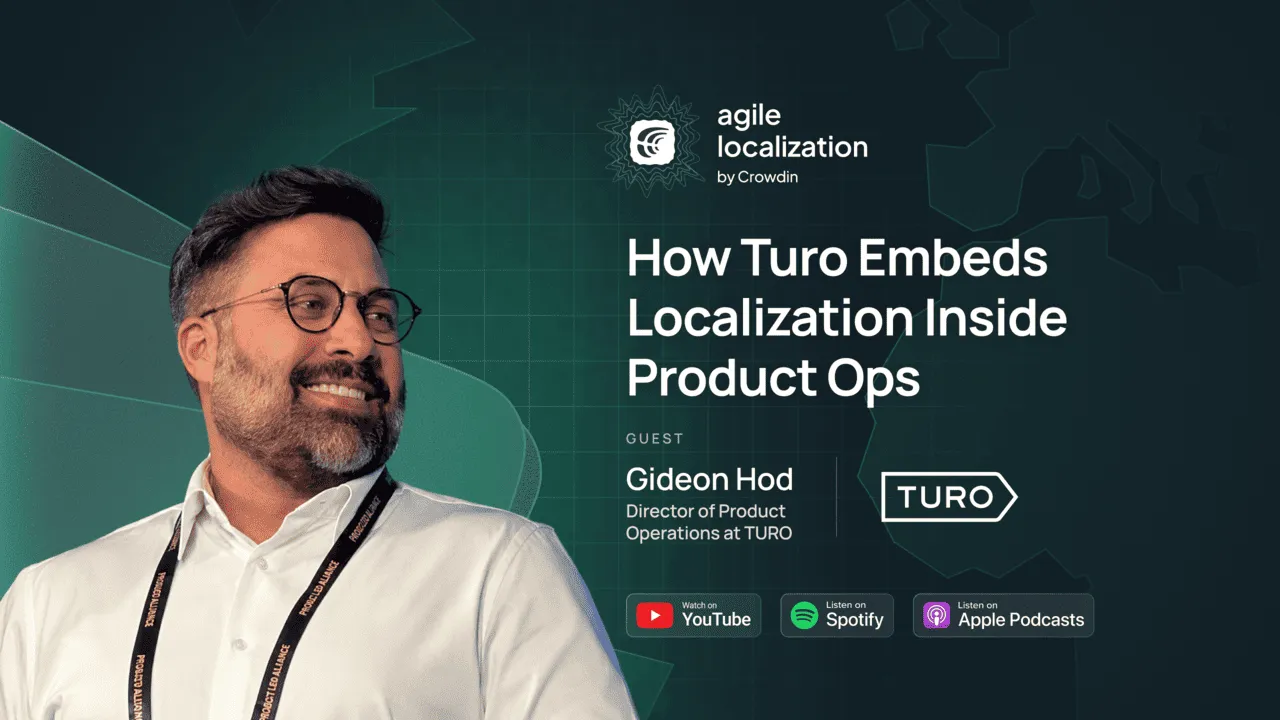
When most companies think about localization, they picture a translation team tucked away in a corner, handling strings after the real product work is done. Gideon Hod sees it completely differently. At Turo, the peer-to-peer car-sharing platform operating across five markets and three languages (with more on the way), localization is a product operations competency that keeps engineering moving fast and users happy worldwide.
Listen to the new episode on:


Treating bad translations like production bugs
One of the most striking things about Turo’s approach is how they prioritize localization issues. A bad translation or a broken UI caused by localization isn’t filed away in some backlog; it’s treated with the same urgency as a production bug impacting the user experience. There are dedicated processes to report issues, route them to engineering, and get them fixed fast.
It helps that Turo’s CEO is multilingual and personally speaks two of the languages the platform supports. He’s often the first person to flag something that isn’t properly localized. Having that kind of executive awareness removes the usual friction of selling localization internally. The buy-in comes from the top.
"We were already Crowdin users. But when I joined, we were using the standard Crowdin product. But shortly after, as we launched in France and wanted to expand to more locales, we quickly realized we needed the Crowdin Enterprise product. Crowdin.com worked well for us when we were just doing one other language besides English, which was Canadian French. But to add more dialects and more languages, it was pretty clear we needed the enterprise product, and we were a quickly growing marketplace that needed to quickly scale to more languages and to support code bases across different systems.
Moving localization upstream into design
Currently, translation at Turo happens toward the end of the development cycle, after design iteration, after English copy is finalized, right around code deployment. Gideon wants to change that. His next big move is pulling localization into the design phase itself, using the Figma-Crowdin integration to get translations decided early. The logic is straightforward: if translations are ready before code ships, there’s no bottleneck for engineering to worry about. And because AI can scale across multiple languages simultaneously, doing this upstream means that launching new languages becomes almost trivially easy.
"Crowdin platform is supporting us really well at exploring new ways to add more languages faster and to do them all simultaneously and to do them without scaling up additional teams or agency relationships, if you wanna launch a language quickly.
The user-generated content challenge
Turo isn’t just a content-heavy platform. It’s interaction-heavy. Hosts and guests communicate constantly, especially around trip logistics like finding a car at an airport parking lot. For a long time, that coordination happened through unlocalized messaging, which created real problems for international travelers.
Turo’s response was twofold. First, they productized much of the trip handoff experience, replacing free-form instructions with structured, localizable UI elements, including airport parting maps. Second, they’re rolling out real-time translation for the remaining user-generated content so guests can make informed booking decisions regardless of language.
The glossary plays a critical role here. Turo has specific terminology, and plugging any old translation tool into user-generated content without vocabulary awareness would quickly erode brand consistency.
AI translators that argue
Gideon’s favorite Crowdin feature right now is the AI translator and proofreader workflow. He’s built translator personas with custom prompts, connected his own LLM API keys, and centralized context from glossaries, translation memory, and previous translations. After the AI translator finishes, the AI proofreader reviews every string and leaves comments, creating a transparent trail of translation decision-making.
Early on, the results were entertaining. The AI agents were pretty combative about the glossary and would sometimes disagree with each other in the comments. But over time, the proofreader got stricter about glossary compliance, and translation memory built up consistency. That transparency gave Gideon the confidence to gradually let the system approve translations autonomously.
How Turo Localized an Entire Ecosystem into Spanish in One Week
What’s getting easier
AI has made it possible for a single person to manage localization quality across multiple languages, most of which Gideon doesn’t personally speak. The cost is almost negligible compared to traditional agency setups, and the speed is transformative: translations that once took days now happen almost instantly.
But there’s a nagging concern in the background: AI compute costs. Everything is inexpensive now, but a compute crunch could change the economics overnight. For the moment, though, the trajectory is exciting. Turo is preparing to add languages with entirely different alphabets, which brings new visual QA challenges around truncation and layout. Until AI can reliably catch those UI issues, some manual review will stick around.
The bigger takeaway from Gideon’s story? Localization professionals who can build and manage AI agent workflows are the ones who will thrive. As he sees it, you might not need to figure out who’s going to translate twenty languages. You just need to figure out how to build the processes for the agents to do it for you.
Gideon’s Background
Gideon Hod is the Director of Product Operations at Turo, a global peer-to-peer car-sharing marketplace operating across multiple languages and markets. With over a decade of experience in product operations, Gideon has developed deep expertise in aligning localization workflows with fast-moving product teams, treating translation quality as a critical business metric rather than a post-development afterthought.
Listen to the new episode on:

Yuliia Makarenko
Yuliia Makarenko is a marketing specialist with over a decade of experience, and she’s all about creating content that readers will love. She’s a pro at using her skills in SEO, research, and data analysis to write useful content. When she’s not diving into content creation, you can find her reading a good thriller, practicing some yoga, or simply enjoying playtime with her little one.